The AI-Native Operating Company
A transformation project will not build it. Found the successor beside the company you already run, and give it a mandate the old one cannot have
Intelligence can scale. Software can perform the work. Grant those two, add a management system that makes the work dependable, and the last question is no longer how much AI an existing company should adopt. It is what kind of company you would build around digital labour if you started today.
Your operation already has a shape. The cost of human labour set that shape. Work was split across departments because different experts were needed at different points. Cases moved through queues because one team had to finish before the next could start. You sampled for quality. Checking every case by hand cost more than the errors did. None of that was chosen for the outcome it produced. It grew around what people could do. The process map records how the company learned to work under those limits. It is not a law of nature.
That shape has to change. Can you do it from inside the company that depends on it? The shape defends itself, and a transformation project run inside it ends up serving it. Build alongside instead, and a second question lands.
The real question is not whether the new company runs the work better. It is whether it can become the company that captures the value your current model cannot.
If work can be delivered through compute rather than headcount, then this is not a process improvement. It is the foundation of a different operating company, with different economics, a different margin structure and the potential to become the consolidator rather than the consolidated.
That takes an operating constitution, a loop that compounds, and one founding capability that is easy to overlook.
You build the successor beside the company you already run, and you own it
That shape does not yield from the inside. You have revenue to protect, systems in place, roles, incentives and customer expectations, all of it built around human delivery. A business that charges for hours may find the new economics cannibalise the model funding the change. Even when the technology works, the organisation pulls the new operation back towards the old one.
A startup has the opposite problem. It can design from first principles, but it does not arrive with customers, licences, operating data or the standing to take responsibility for a regulated service. It can demo well without being able to carry the outcome. Market access is the one asset it cannot write from scratch.
You hold what the startup lacks. The startup is free of what holds you. So build the successor beside the company you already run, and own it.
Found two assets. An operating company sells the outcome to the customer and answers for it. An AI venture builds the intelligence that makes the outcome cheap, and owns the method for building it again. You own both.
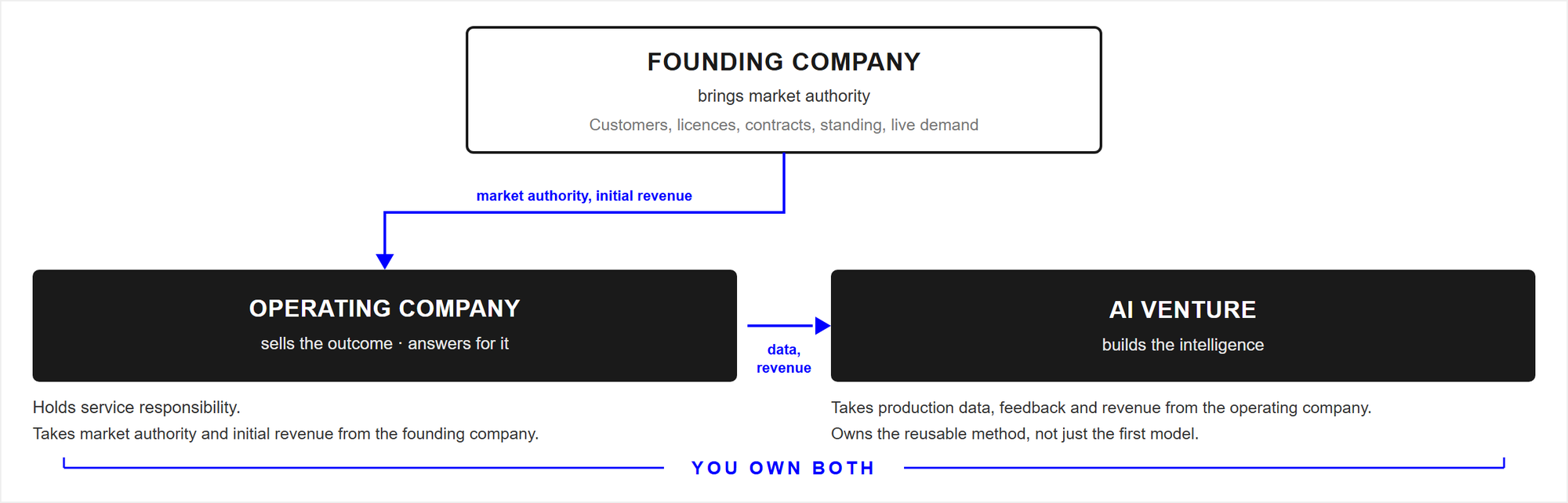
That is the structure. Whether it prints money depends on what you put inside it.
Most transformations automate the constraints they should remove
Most AI programmes begin by studying the current operation. Teams document the process, find the slow stages, and look for tasks an agent can take. The result is often a useful assistant, or an agent bolted onto a system that stays as it was. The operating model underneath does not move.
Start there and you automate the constraints that built the process in the first place. The queues, the hand-offs, the sampling: each one was an answer to the limits of human labour. Encode them into your AI design and you carry the old company forward at higher speed.
An AI-native company begins somewhere else. It begins with the outcome and works back. What did you promise the customer? What legal and regulatory duties must you meet? What has to be gathered, what decided, what evidence has to exist afterwards to prove the work was done correctly?
That produces a different blueprint. It is a model of obligations, decisions, evidence and outcomes. It does not begin as a list of human tasks.
Design the company from the work backwards, and keep people where judgement requires them
From that blueprint you can mark the boundaries. Which decisions must stay with a person because the law requires it. Where an action is irreversible. Where genuine judgement and accountability cannot be delegated. Everything between those points becomes the new engine room, engineered for digital execution by default.
This is a design discipline. Every point where a human stays in the loop should have a defined reason behind it, tied to law, consequence, judgement or accountability. The shape of the old process does not count as a reason.
The human role changes. In most operations, experts spend the day on cases that need no real judgement. They read the file, confirm the normal rules apply, and move it to the pile marked “nothing unusual here”. They are there because the operation cannot know in advance which case will need them.
An AI-native operation turns that around. The system handles the full volume, applies the rules, and surfaces the cases that fall outside them. People stop reading everything to find the few that matter. Experts set policy, draw the decision boundaries, work the hard exceptions, and watch whether outcomes stay fair, compliant and commercially sound. Judgement gets concentrated on the moments where it changes the result.
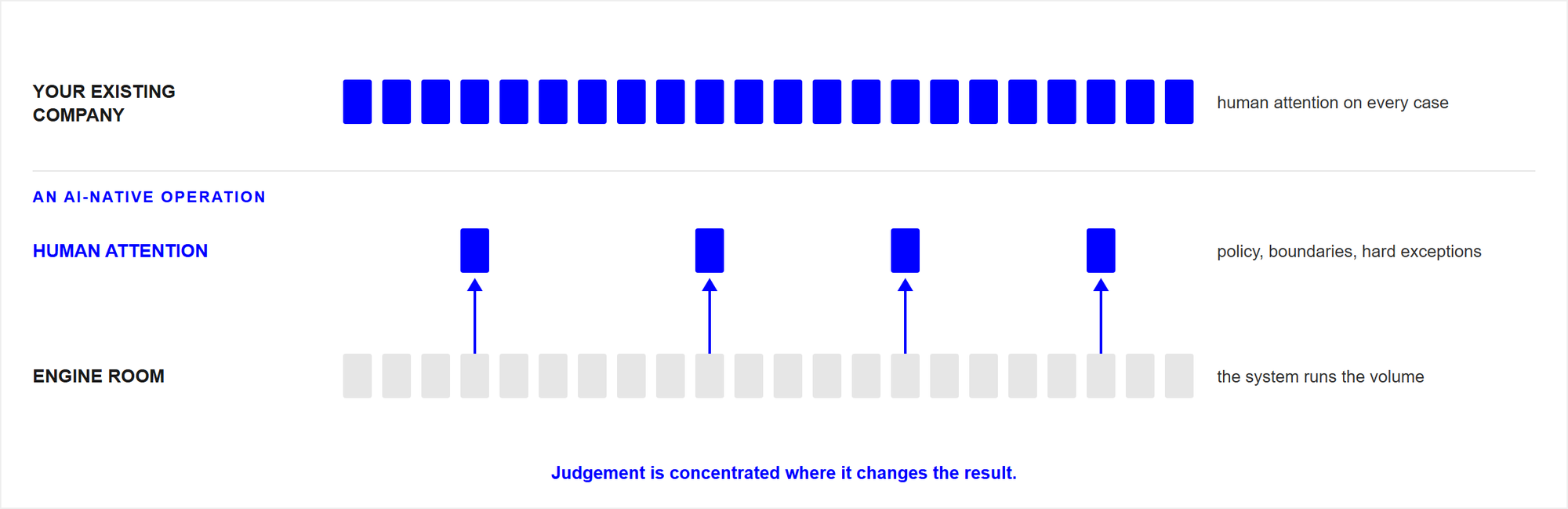
Scale raises the stakes. When work scales with compute, errors scale with compute too. So the controls have to earn their place in the new design. Once it is clear which cases behave predictably, work that needed approval up front can shift to review after the fact. Humans hold the rules. The agents run the engine room.
The durable asset is how the work should be done, encoded as an operating constitution
The foundation of that engine room is not the model. Capability rises, cost falls, and today’s best model is next year’s default. The model is the fastest-depreciating asset you will buy. More precisely, it is usually one you rent.
The durable asset is your own understanding of how the work should be done. The legislation that applies. The contracts. The operating policies, product rules, decision rights, evidence requirements and escalation thresholds. What a good outcome looks like, what tends to go wrong, how to handle uncertainty. Written down and structured so a machine can execute it, this becomes an operating constitution.
It is more than a data lake, and more than a pile of documents behind a chatbot. Y Combinator describes a related requirement as making the company “queryable”: capturing decisions and operational knowledge so an intelligence layer can reason across them and close the loop between what should happen and what does. The company becomes legible to its own agents. They read the case, apply the constitution, take the permitted actions, and keep the evidence behind every call.
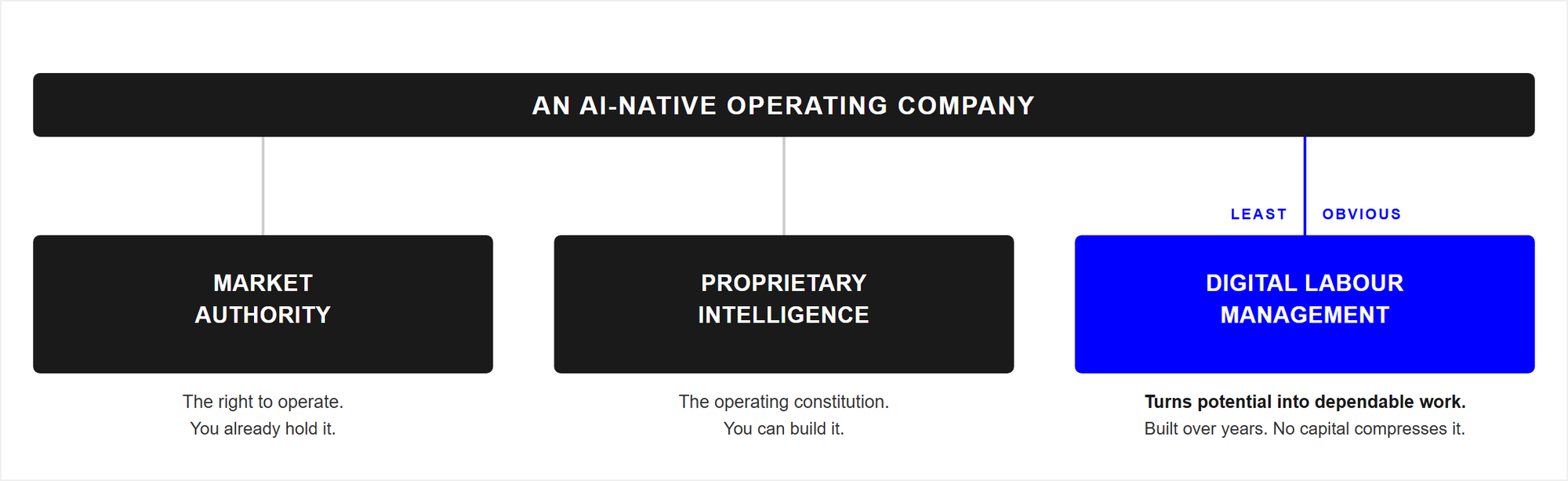
The successor needs three founding capabilities, and the third is the least obvious
The first two capabilities are relatively easy to see. One gives the new company the right to operate in the market. The other gives it the intelligence through which the work can be done.
The third is less obvious, which is precisely why it matters. It is the operating capability that turns potential capacity into dependable work. Without it, the structure contains customers and technology, but not yet a functioning operating company.
Market authority. The customers, contracts, licences, proprietary data, domain expertise, and the legitimacy to take responsibility for the service. This is usually held by the business you already run. It is the right to operate.
Proprietary intelligence. The operating constitution described above: the structured rules, obligations, decision rights, evidence requirements, escalation logic, data models, orchestration and agent capabilities that define how the work should be done. The company that runs the work owns it, and the AI venture owns the method that can build it again.
A digital labour management system. The capability to turn AI potential into dependable work: deploying the digital workforce, holding it to a standard, proving it met that standard, and stepping in as models, systems, rules and volumes change. Software can watch the workforce. This is what answers for it, and every AI-native operating company needs one.
The third is the most important. Teams treat it as implementation support, added once the architecture has been decided. That is the mistake. It belongs in the founding design.
Technology creates potential capacity. An operating company of any kind creates value only when the work is completed reliably, to standard, over time. Someone has to accept continuous responsibility for that conversion. A workforce on compute can scale, but the scaling is bounded by cost, reliability and how well the work can be governed. Moving the constraint is not the same as removing it.
So the founding move is three-handed and the hands sit in two assets. The AI venture builds the intelligence. The operating company holds the right to operate, taken from the business you already run, and accepts responsibility for turning that intelligence into dependable work. Take away the third and you have technology and market access, and still no operating company.
Notice what kind of capability the third one is. Market authority you already hold. Intelligence you can build. Years of carrying live regulated work through model changes and volume swings are neither of those, because no founding plan produces them and no capital compresses them into a quarter.
The company gets better because it operates
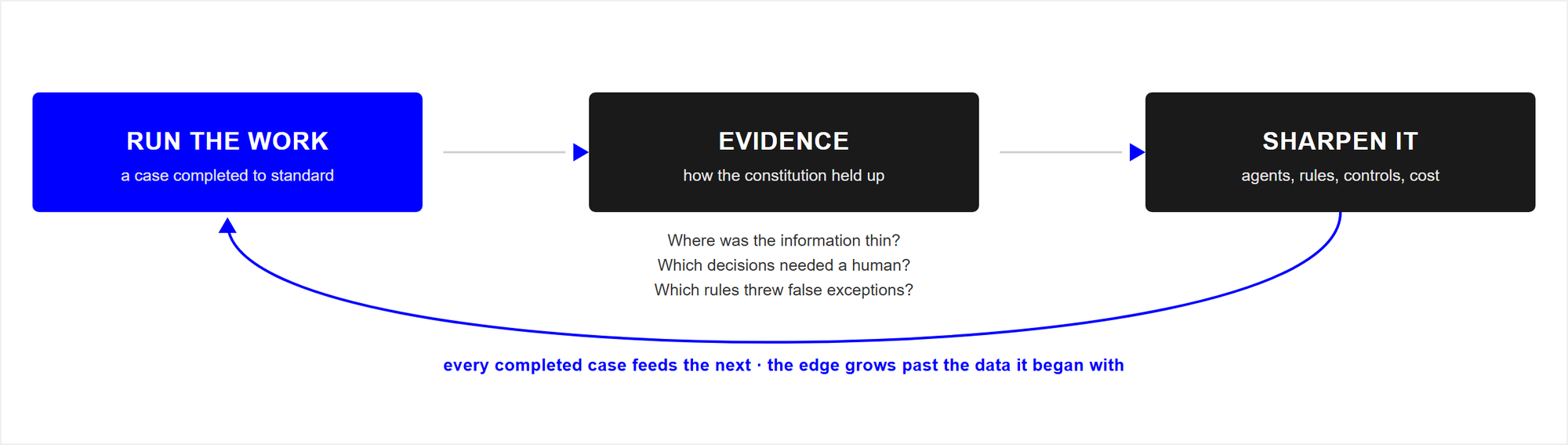
An AI-native operating company is not finished on launch day. It compounds through use. Every completed case produces more than a customer outcome. It produces evidence about how the constitution held up. Where was the information thin? Which decisions needed a human? Which rules threw false exceptions? That feedback improves the agents, the rules, the controls and the cost line.
A standalone software vendor struggles to build this loop. It sees how customers use the tool. It does not own the finished work or the outcome. The operating company owns both. It connects the decision, the action and the result, so its edge grows past the data it began with. A new regulation gets written into the constitution once, then applied across the whole volume.
The margin sits in the work, and it keeps getting cheaper
Sequoia frames the commercial shift as copilot to autopilot: a copilot sells a tool to a professional, an autopilot sells the finished work to the buyer. Already-outsourced, intelligence-heavy services are the strongest place to start, because the budget, the buyer and the acceptance of outside delivery already exist. The operating company uses your market access, data and expertise, and delivers through an engine room built around digital labour. It is the autopilot. That is what it sells, and that is what it gets paid for.
As work moves from human processing to governed compute, price and cost come apart. What the customer pays is set by what the work costs them today with their own people, and that number is not falling. What it costs you to produce is set by compute, and that number keeps falling. The operating company captures the distance between them. It can also consolidate, acquiring books of business and migrating their volume onto the cheaper core. This is the asset that disrupts the category. It prices the work, and the work keeps getting cheaper to do.
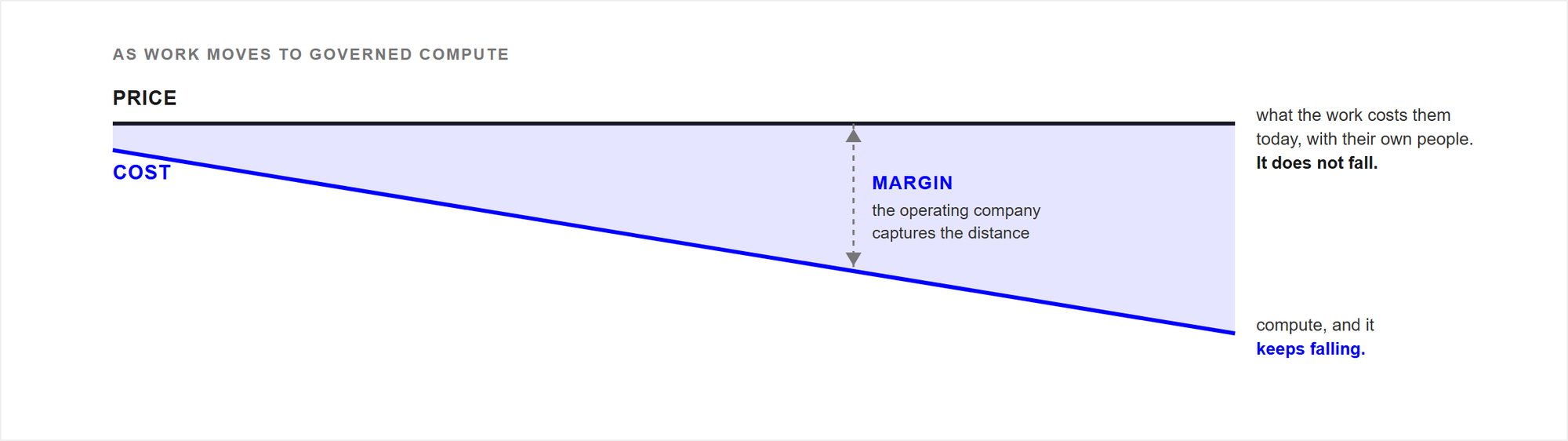
That falling cost has one engine, and it is not the model. The only scale economy here is how much of your work runs autonomously, in your tasks, to your standard. That is a property of the constitution. A good one keeps cases away from people. It also reaches with a small open model what a weak one cannot reach with the largest and most expensive on the market. Human cost and model cost fall for the same single reason. Volume is what matures a constitution, and whoever runs the work first has run more of it.
The constitution and the data belong to the operating company. It runs the work and answers for it, so it holds the rules and the record. What the AI venture owns is the method: how a constitution gets built out of law, contract and policy, how an engine room gets assembled around it, how the loop gets closed. That method travels, and the same operating model can be founded again in another market, another industry, under another regulator. A software vendor can travel too, and the good ones do. What a vendor never gets is the finished work in front of it, because it sold a tool and the customer kept the outcome. The venture gets it, because its anchor customer is the company doing the work, and that puts production data in its hands from the first case.
Keep the two separate and each stays honest. Bury the method inside the operating company, and delivery pressure turns a reusable discipline into a pile of customer-specific fixes. Put all the ambition inside the AI venture, and it drifts back to selling licences, because that is easier than standing behind the work. The separation also creates two investment profiles: a service business built on revenue, margin and consolidation, and a technology business that can take its method into new markets.
You are choosing which company to build
This series began with three ways of valuing AI: save, protect, disrupt. Buying a tool became hiring software. Then trust turned out to be where value gets proven, and what earns that trust is a digital labour management system, an operating capability built up over years. The last implication is structural: once digital labour is dependable, the company itself can be redesigned around it.
Slow AI adoption is the wrong thing to fear. A competitor can use the same technology to build a different operating company, take your customers, and consolidate the market before you finish.
Some leaders will build it inside the company they already run. For others, the legacy business is too valuable to stop and too constrained to reinvent at speed. In that case the more credible move is to build the company that would disrupt you, and to own it first.
Both of those are decisions about which company you are running in ten years. Which company is your AI discussion actually about?
Sources
- Making the company “queryable”, so an intelligence layer can reason across decisions and close the loop between what should happen and what does: Y Combinator, Requests for Startups. https://www.ycombinator.com/rfs
- Copilot to autopilot, and already-outsourced intelligence-heavy services as the strongest starting point: Sequoia Capital, “Services: The New Software.” https://www.sequoiacap.com/article/services-the-new-software/
About the author
Karli Kalpala is the Chief Strategy Officer and the Head of AI Agent Business at Digital Workforce.
Share this post