Save. Protect. Disrupt. Three AI value drivers.
Why AI conversations sound different in Helsinki, London and Silicon Valley
The same technology sits in every room. The ambition in each one is different.
You hear a different AI conversation in Helsinki, London and Silicon Valley
After presenting to executive teams and boards, I get one question more than any other. How does the AI discussion in Finland differ from what I see in London or Silicon Valley?
The intuitive answer is “a lot”. It took me longer to answer the question underneath it. Different on what dimension?
So I start by ruling things out. It is not primarily about access to technology. The same foundation models, the same platforms, the same technical capability are on sale in all three markets. It is not budget or talent either. Strong companies and capable leaders sit in every one of these rooms.
So if the inputs are the same, why do the conversations sound so different?
Each room is chasing a different kind of value
Adoption is not the variable either. It is climbing almost everywhere. More than a third of Nordic enterprises already use AI. The EU average is nearer a fifth. On this one-dimensional measure, the region is not behind.
If everyone can buy the technology and everyone is adopting it, the difference cannot be the tool. The difference is the value driver the conversation revolves around.

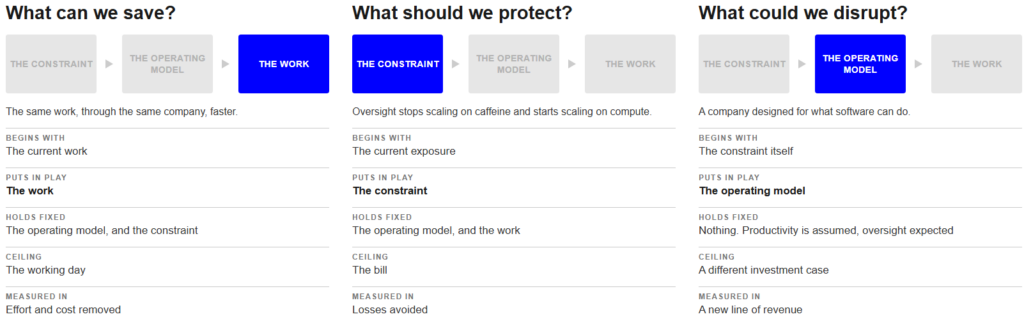
In the Nordics, it usually begins with the most immediate thing AI can offer. Saving. How do we save time, cut cost, make people more productive?
In London, it moves somewhere else, especially in regulated financial services. Protecting. What should we already be doing but cannot, because we have never had the people to do it?
In Silicon Valley, the most ambitious version has moved further again. The question is no longer how to improve or defend the company you already run. It is whether AI lets you build a different kind of company altogether.
Three rooms, three different questions about the same technology.
Save. Protect. Disrupt. The technology may be the same. The ambition is not.
This is not a league table. The US room is not “ahead” of the Helsinki room. These are three ways of valuing the same technology, and every one of them is open to any leader in any market.
Save: the fastest thing your rivals can copy
Save is where almost every AI journey begins, and it should be.
The questions are familiar, because they follow the logic of every technology wave before this one:
- Can we automate this task?
- Can one person do in an hour what used to take a day?
- Can we run the same operation at lower cost, with fewer errors?
These are sensible questions. Most organisations still carry a large amount of repetitive knowledge work that ought to be automated. AI can lift the administrative weight off people and let scarce experts spend their time on the decisions where their judgement matters. In economies where the workforce is ageing and skilled labour keeps getting more expensive, that is worth real money.
But saving usually accepts the current operating model as fixed. The same work moves through the same organisation, only faster. When a capability becomes broadly available, its productivity gains spread. Your competition buys the same model and has access to the same API. What first looked like an edge becomes the baseline everyone is measured against. Saving is also the part a rival copies fastest, which makes it the least defensible place to concentrate your spending.
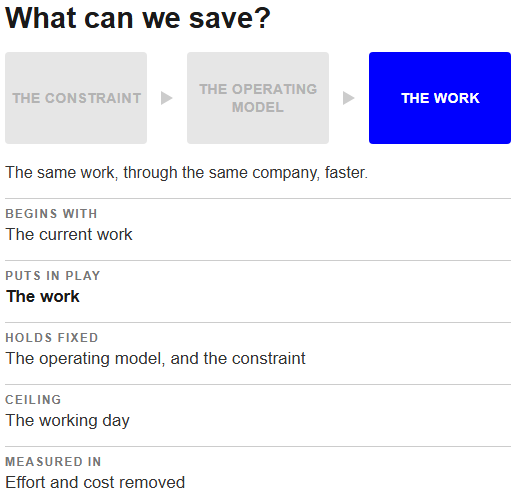
Hand every employee an assistant and they get more done in a day. Bolt an agent onto a process and it moves faster. The work still runs through the same people. So when you want more output, you meet the old constraint again: the number of people available to do the work. The employee stays the unit of production. Whatever technology sits on top, the company is still scaling on caffeine.
Save raises the floor. It rarely decides who wins.
Protect: reveal the work human attention was too scarce to do
The conversation becomes more interesting when the value driver shifts from productivity to protection. This is where I increasingly find London, particularly in financial services. Cost and productivity are on the table, but they are rarely the questions that get the strongest reaction in the room.
The question that does is this one. What have we always known we should be doing, but never had the people to do properly?
Most leaders can answer straight away. Review every transaction rather than a small sample. Test controls continuously rather than periodically. Check every contract against the rules. Watch the quality of decisions as they happen, rather than finding out months later through an audit, a complaint or a regulator.
None of these ambitions is new. They were impossible because they ran on human attention, and human attention was too expensive to spend on all of it. When oversight depends entirely on that attention, you are forced into compromises:
- You sample instead of reviewing everything
- You watch the risks you already understand
- You run periodic checks, because continuous oversight would need a workforce no business could justify.
An agent changes that arithmetic. If it can read the underlying evidence, apply a defined control, explain its reasoning and escalate when it is unsure, you can review work at a scale you could never staff.
Why does it scale? Because the queue changes shape. People review cases one after another, so ten thousand cases cost ten thousand times the attention. Agents review cases alongside one another. Ten thousand finish in close to the time one takes, because a server rack adds machines where a team can only add hours. Oversight used to scale on caffeine. This scales on compute. The ceiling stops being the working day and becomes the bill.
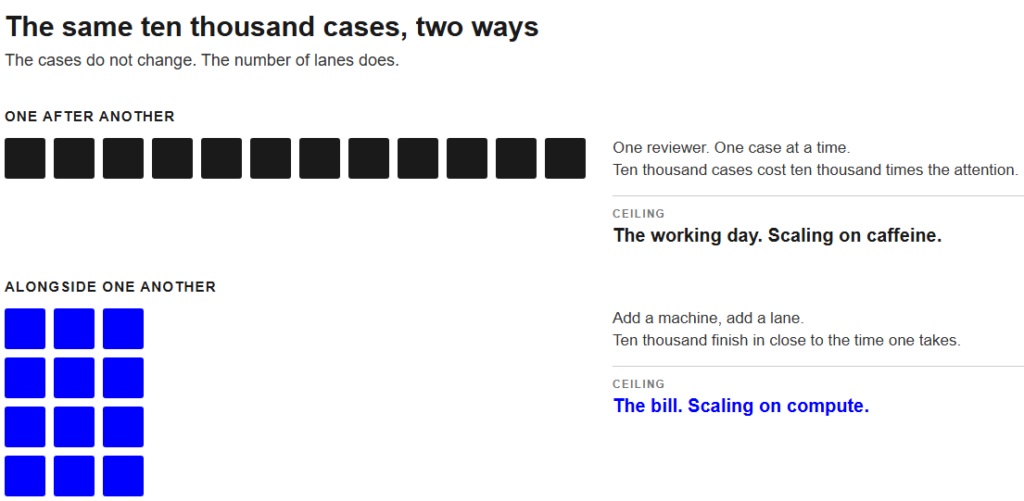
The goal shifts. You are no longer just doing the same review faster. You are reaching the cases nobody ever looked at.
Notice what the London prize actually is. It is coverage and control, and speed is secondary. The value is risk made visible, losses avoided and confidence gained.
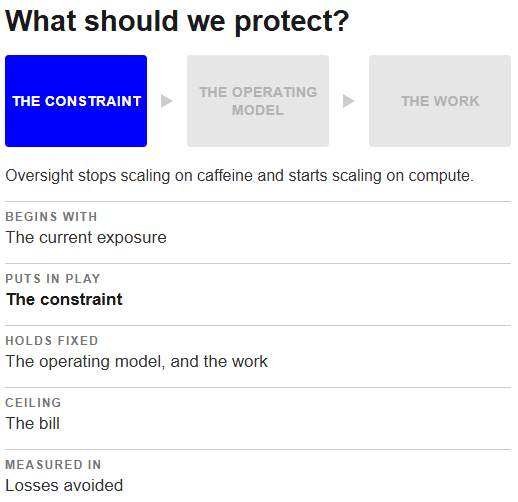
Save asks how much effort can be removed. Protect asks how much exposure has existed because human attention was too scarce.
Disrupt: ask what company becomes possible once intelligence scales
Disrupt starts from a different premise. Productivity is assumed. Better oversight is expected. The strategic question underneath is what kind of company can exist once intelligence becomes scalable and increasingly commoditized.
For decades, software and services businesses have lived under different economic rules. A services company grows by adding people. More customers mean more consultants, analysts, handlers, specialists. You can raise utilisation and standardize delivery, but revenue and headcount stay roughly tied together. A software company grows the other way. Once the product exists, it can serve the next customer without rebuilding the delivery organisation.
AI begins to weaken the wall between those two models. Software used to help a professional deliver a service. It can now perform larger parts of the service itself. The work can move into the software.
That sounds like a technical detail. The economic consequence is not. Take a company whose service is reading documents, interpreting policy, weighing evidence, making a recommendation, communicating a result. Historically, more volume meant more people who could do those things. Encode those activities into an agentic system, and capacity starts to scale with compute instead of recruitment. You still need experts, but the job changes. They set the rules, watch the outcomes, handle the uncertainty and step in where judgement genuinely earns its keep.
This is the thinking behind what some venture investors call Service-as-Software. The budget for work is far larger than the budget for tools, and the company that delivers the outcome can capture more value than the company that merely sells a better tool to the incumbent provider. The opportunity may not be selling one more application to the existing provider. It may be becoming a new provider whose service is delivered mostly in software.
So the disrupt question is a bigger one. What company would you build if you were no longer bound by the old ratio between headcount and output? You cannot answer that with a list of use cases. It asks you to reconsider the design of the operating company itself.
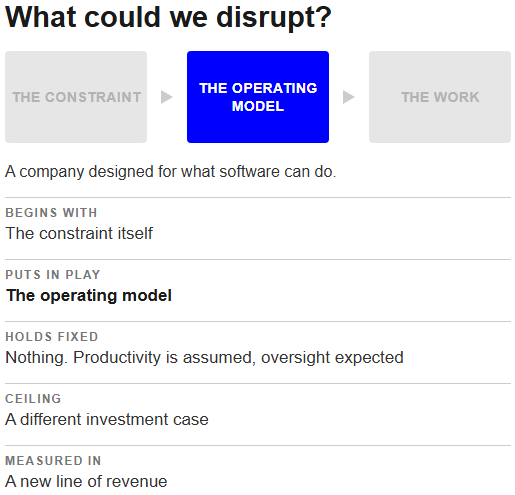
Collapsing all three into one list hides the strategic choice
Save, protect and disrupt are not three tidy stages every organisation climbs in order. A company can run all three at once. It might use AI to save hours in one function, widen risk oversight in a second, and build a genuinely new business in a third.
The distinction earns its keep because it exposes the ambition behind the spend. Save begins with the current work and asks how to perform it more efficiently. Protect begins with the current exposure and asks what important work is missing. Disrupt begins with the constraint itself and asks whether the existing operating model should survive at all.
This is also why AI strategies so often feel scattered. A productivity assistant, a control-testing agent and an AI-native operating company can all land on the same slide as “AI initiatives”, yet they are not trying to make the same kind of value. Collapsing all three into one list of use cases hides the strategic choice. They create different value, require different evidence and deserve different investment logic. The money shows the same split. Saving is measured in effort and cost removed. Protecting shows up as losses avoided and risk carried safely. Disruption often needs an entirely different investment case, because its return is a new line of revenue that the old cost-out logic was never built to measure.
Two decisions your company has always kept apart are becoming one
At the edge of the disrupt conversation, another old boundary begins to disappear. For more than a century, Procurement has bought technology and HR has hired labour. When software performs the work, those two decisions begin to converge.
Physics went through a version of this in 1908. Hermann Minkowski was working in the wake of Einstein’s special theory of relativity. Space and time had long been treated as separate categories. The new physics could only be understood by seeing them as one joined reality.
“Henceforth space by itself, and time by itself, are doomed to fade away into mere shadows, and only a kind of union of the two will preserve an independent reality.” Hermann Minkowski, Space and Time, 1908
Replace space and time with Procurement and HR. The technology decision becomes a workforce decision, and the workforce decision becomes a technology decision.
Your ambition decides how far the conversation goes
Looking back, I do not think the real difference between Helsinki, London and Silicon Valley is geography. The locations just make the three paradigms easy to see. You can ask all three questions from any chair:
- What can we save?
- What should we protect?
- What could we disrupt?
Most teams stop after the first. The other two stay available and go unasked, and the ambition settles at the level of whatever got raised.
Productivity is a fine place to start. The danger is not starting there. It is mistaking the first conversation for the whole opportunity, because in its most consequential form the same technology that trims a cost line can also make a different company possible.
The technology may be the same. The ambition is not.
Once software can hold a role and carry the work to an outcome, a new question arrives with it. You are no longer deciding which tool to buy. You are deciding who will do the job. Or what. That is the subject of the next article: You are no longer buying tools. You are hiring software.
Sources
- Enterprise AI adoption in the EU and the Nordics (the Nordics past a third of enterprises, the EU average nearer a fifth). Eurostat, use of artificial intelligence in enterprises. https://ec.europa.eu/eurostat/web/products-eurostat-news/w/ddn-20251211-2
- Hermann Minkowski, “Space and Time” (address to the 80th Assembly of German Natural Scientists and Physicians, Cologne, 1908).
About the author
Karli Kalpala is the Chief Strategy Officer and the Head of AI Agent Business at Digital Workforce.

Share this post