Who do you trust to run your digital labour?
The build creates potential. The work creates value.
Work is a word we use loosely. It can mean a job, a task, or the place we go each morning. Physics is stricter. A system can hold potential energy, the stored capacity to do work, and hold it indefinitely without producing anything at all. Work happens only when that capacity meets something and changes it.
Stored capacity and applied effect are different things. That gap decides who captures the value in the AI agent economy.
A demonstration proves the potential exists, and nothing more
Human work is local to the time and place where it is performed. A task can sit in a queue and wait. Yesterday’s unused hour cannot. It is gone, and it cannot be saved up and released tomorrow. The capacity to do the work can be present all day long, and still nothing is produced until that capacity meets a real task and an outcome comes out the other side.
Digital labour changes the unit that delivers the work. It does not change that truth.
An agent that has been designed, tested and deployed is potential productive capacity, and for now only that. A demonstration proves the potential is real. It proves very little about next month. It does not prove the work will keep arriving, keep being completed to the required standard, and keep being completed as data, policy and the surrounding systems change underneath it. A demo is a single good moment under conditions you chose. Production is a stream of moments you do not get to choose.
So the build creates potential. The work creates value.

There is a reason the build gets the attention. It is the part you can see. A working demonstration is a moment you can put in a room and watch land. The value accumulates later, in the part you cannot put in a room: the same case handled correctly for the ten-thousandth time, the exception caught at two in the morning, the migration that quietly did not break anything. Budgets tend to follow the visible thing.
This is why the contest is not decided in the build. The build matters, the way recruitment and training matter in any organisation. But no company creates value by owning capable people. It creates value when the work of those people reliably produces the outcomes the business exists to deliver. The previous article in this series described the moment software stops being a tool you buy and becomes labour you hire. This is the invoice that arrives with hiring.
Digital labour calls for management, the way human labour always has
Once software becomes labour, the honest comparison sits closer to home than most technology thinking allows. Maintenance keeps a system available. Management turns capacity into work. Digital labour needs the second discipline, and it is the harder one.
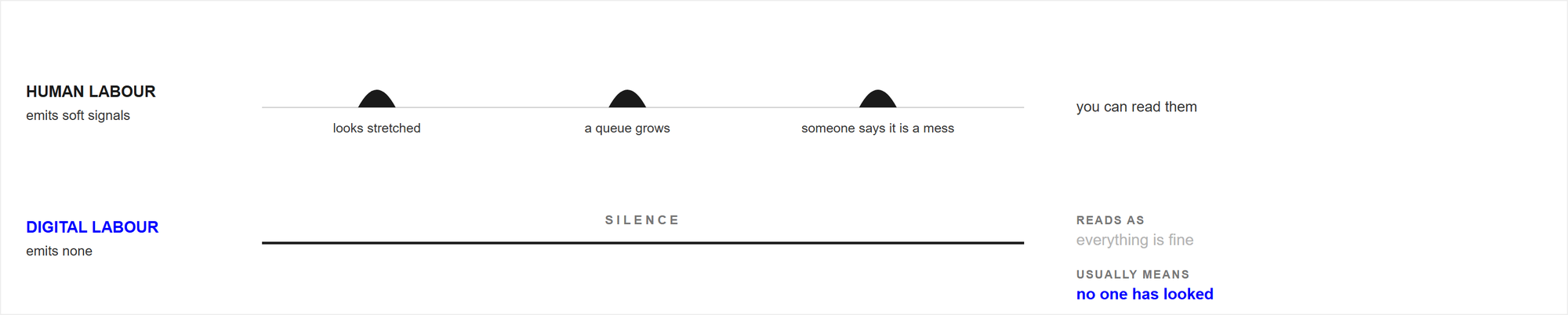
Human organisations have spent centuries building that discipline. Managers allocate the work, watch how it is going, clear the obstacles, and step in when quality slips. A great deal of that runs on soft signals. A colleague looks stretched. A queue is visibly growing. Someone says out loud that a process has become a mess and needs fixing.
Digital labour sends none of those signals. An agent never looks busy. It never mentions that a case got confusing halfway through. It will follow a subtly wrong instruction ten thousand times without hesitation and without complaint. The silence can read as everything being fine. Usually it just means no one has looked at the execution and results of the work.
The job of managing changes shape too. Overseeing people, you read attention, effort and mood, and much of the work is managing motivation. Overseeing agents, you read evidence, configuration and exceptions, and the work is managing the system that produces the outcomes. Those instincts do not transfer cleanly.
The real measure is whether the work is getting done
In practice, evidence comes down to plain questions. Did the task actually arrive? Was it completed to the standard the business is accountable for? Were the exceptions noticed and handled, or did they quietly pile up out of view? Does the record behind each decision still exist if a regulator, a customer or an auditor asks in a year?
These are not product features to tick off. They are the shape of the question that whoever manages digital labour has to keep answering every day, as the volume rises and the rules shift. A running system tells you the software is available. It does not tell you the work is getting done.
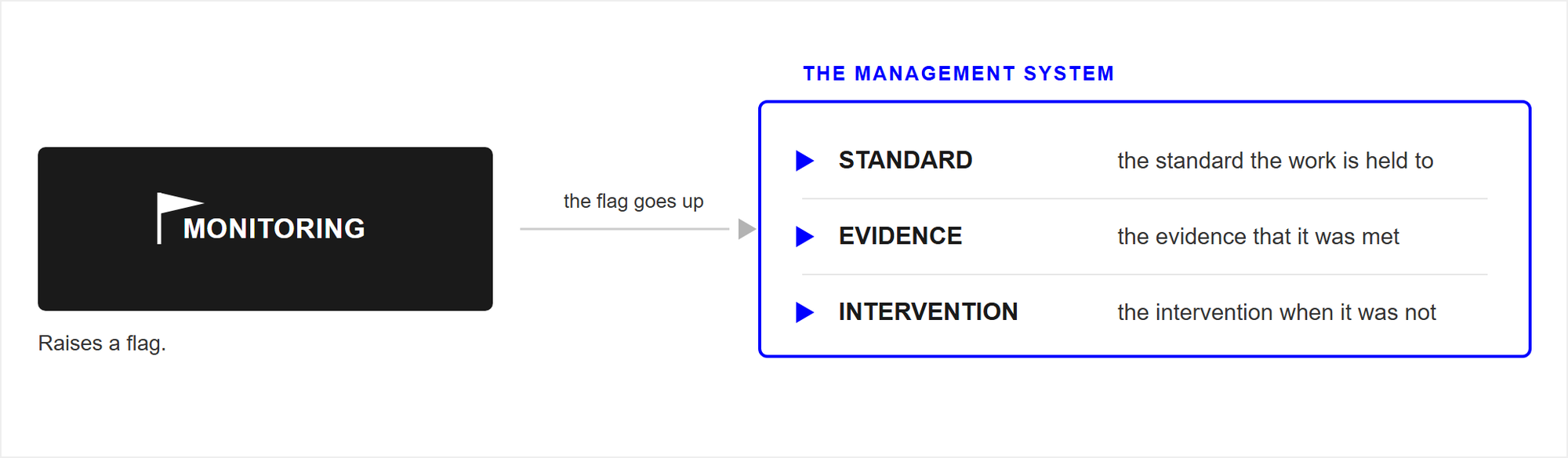
Give that work a name. It is a digital labour management system: the standard the work is held to, the evidence that it was met, and the intervention when it was not. A monitoring tool can raise a flag. The management system is what happens after the flag goes up. Without it you are left with running software and a hope, and no way to tell the two apart.
Trust is the accumulated evidence that capacity keeps becoming correct work
This quietly changes what trust means. Trust here is not a feeling about a model. It is not a score from one good week in testing either. A model can pass every check in the lab and still drift the month an upstream data format changes or a policy gets rewritten. Trust is the accumulated evidence that productive capacity keeps turning into correct work, run after run, while the ground moves underneath it.
The second article in the series placed trust at the crown of the buying decision. This is what holds the crown up. Value exists only in work that is actually performed, so whoever can keep performing it reliably is the one the trust attaches to. Trust is an operating capability. It is built slowly in production, out of a long record of the work getting done. You cannot sign it into a contract or prove it in a pitch.
That shifts the question a buyer is really asking. The comparison used to be between models and platforms, judged on what they could do inside a controlled test. The sharper comparison now is between the parties who will stand behind the work once the test is over and the volume is real. You can assess raw capability in an afternoon. An operating record takes years to build and cannot be borrowed from someone else.

The technology changes, and the responsibility does not
This is the part a demonstration cannot teach. We learned it over more than a decade of running software-based workers in live processes, in work that got steadily more critical. We have kept them running through the messy middle of live operations, long after the original project team has moved on. The technology kept changing, from scripted automation to autonomous agents that reason through a case. The responsibility did not move at all. Someone still had to know whether the work was being done, act when it was not, and keep the productive system dependable as everything around it shifted. That someone has a role, and the role deserves a name: the operator of digital labour. The operator owns the outcome.
The economics change only when evidence lets responsibility move to software
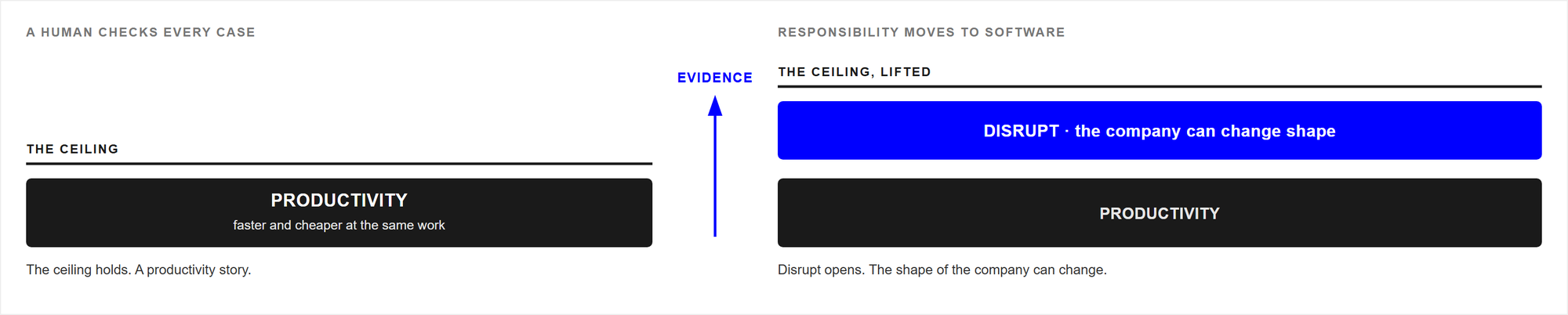
This operating capability sets the ceiling on how far a company can move past plain productivity. If a person has to check every output an agent produces, the agent makes that person quicker and the company still scales through human attention. The old headcount constraint has not gone. It has moved one step back and put on a new coat.
The economics only change when the evidence is strong enough to let more responsibility move safely to software.
There is a strategic edge hidden in that ceiling. A company that never builds the evidence to lift human sign-off from every case stays a productivity story. It gets faster and cheaper at the work it already does, and that is worth having. The larger prize is the one the first article called Disrupt. It opens only when the work itself can run on dependable software and the shape of the company can change. That door stays shut until the operating question is answered, however good the technology gets.
Intelligence will keep getting cheaper, and potential productive capacity may end up close to free, running on compute rather than caffeine. Work stays stubbornly local to the moment its outcome is produced, and someone still has to stand behind that outcome. Cheap intelligence does not remove that person. It raises the value of whoever can answer for the work.
So the question worth asking reaches past whether you trust AI.
Who do you trust to ensure that your digital workforce gets the work done?
Series bridge: once digital labour can be operated as dependable productive capacity, the last question is structural. What kind of company should be built around it? That is the subject of the final article, The AI-Native Operating Company.
About the author
Karli Kalpala is the Chief Strategy Officer and the Head of AI Agent Business at Digital Workforce.
Share this post